When it comes to establishing an LLC in the United States as a foreigner (Foreign Owner), the question arises whether to opt for a Multi-member or Single-member LLC. We will explore the advantages of each and give you an option to avoid having a Multi-member LLC since it requires greater maintenance.
LLC Multi-member Foreign Owned, What is it?
A multi-member LLC, as the name implies, is a limited liability company in the United States formed by two or more foreign owners. It can be treated as a corporation or pass-through, and through Form 8832 the tax election for the LLC can be chosen.
Multi-Member LLC Operations
Just like single-member LLCs, MMLLCs grant limited liability to their members. This means that partners enjoy a certain degree of protection for their personal assets. This concept was borrowed from corporations, ensuring that the personal assets of the members are protected if the LLC is threatened by a lawsuit.
How are multi-member LLCs taxed?
A multi-member LLC is more complex than a single-member LLC. It is taxed as a partnership. You have to file Form 1065 which requires reporting all income and expenses, and if income or assets are more than $250,000 or more, you also have to make a balance sheet.
However, it is crucial to understand that, although the LLC itself does not pay taxes, each member must report their share of the income on their personal tax returns using Form K-1. This ‘pass-through’ approach can be beneficial in terms of tax planning, allowing members to take advantage of potential personal tax deductions and credits. It is advisable to consult with a tax advisor to optimize this structure for the benefit of all members.
Additionally, LLCs have the option to choose whether they want to be treated as transparent (pass-through, disregarded) or as a corporation or partnership. This is done through the formEntity Classification Election 8832.
Key Information About Form 8832
Form 8832, «Entity Classification Election», allows LLCs in the United States to choose their tax classification. It is crucial to determine whether an LLC is treated as a corporation or as a transparent (pass-through) entity. By filing this form, the LLC can change its tax classification, which affects how it is taxed.
This election is binding for five years and has significant tax implications. For example, an LLC treated as a corporation files Form 1120, which is more complex and could increase the tax burden. Instead, as a pass-through entity, income and deductions are reported directly on the members' personal tax returns.
It is advisable to consult with a tax advisor before making this decision to fully understand its consequences.
Practical Case Multi-Member LLC
Scenario: Maria, a US citizen, and Carlos, a Mexican citizen, decide to form a Multi-Member LLC in California to invest in real estate in the United States.
Operation: Maria and Carlos are the partners of the LLC and share the responsibility for management and decision-making. The LLC operates as a partnership, which implies that they must file Form 1065 to report the company's income and expenses.
Taxation: The Multi-Member LLC is taxed as a transparent partnership, and Maria and Carlos receive K-1s showing their share of income and expenses. Each partner is responsible for declaring their share of the income on their personal tax return in Mexico.
If Maria were not a US citizen and the activity did not take place in the USA, one could operate with a single member + the operating agreement contract.
Create my LLC with Northwest →
Affiliate link: if you sign up through it, EluTax receives a commission at no extra cost to you. It does not replace professional tax consulting.
Cases in which a Multi-Member LLC is more Attractive
The choice of a multi-member LLC can be especially beneficial in certain scenarios where collaboration, investment, and shared management are crucial. Cases in which opting for a multi-member LLC could be more advantageous:
Risk and Investment Diversification:
- Multiple Investors: In situations where a business requires significant investment, having multiple members can facilitate the accumulation of necessary capital without financially overburdening a single investor. This allows for diversifying risk among members.
- Protection against charging orders: Members of a multi-member LLC generally enjoy additional protection against personal creditors, who can only access the members' distributions and not the company's assets.
Businesses with Complex or Large-Scale Operations:
- Operations Management: For companies operating in sectors with complex logistics or that require constant and diversified operational management, having multiple members who can share management responsibilities can improve efficiency and decision-making.
Succession Planning and Business Continuity:
- Gradual Transfer of Interests: In family businesses, a multi-member LLC allows for structured succession planning where interests can be gradually transferred to the next generation, ensuring business continuity.
Flexibility in the Tax Structure:
- Taxation Options: Multi-member LLCs offer flexibility in choosing how to be treated for tax purposes just like a Single Member LLC, the advantage is that Multi Member Manager Managed will give us much more privacy and options to optimize tax burdens among members according to applicable regulations and tax benefits.
- Income and Loss Distribution: The ability to allocate income and deductions among members can result in optimized tax benefits, tailored to the individual tax situations of the members.
- Flexibility in Expense Deduction:
Tax Optimization through Deductions: Multi-member LLCs report their income and expenses through Form 1065, which provides a significant opportunity for tax optimization. This form allows members to report a wide range of deductible expenses that can considerably reduce the company's taxable base.
Distribution of Income and Expenses Among Members: Furthermore, the structure of a multi-member LLC allows for a strategic distribution of income and expenses among the members as agreed upon in the operating agreement. This flexibility is particularly advantageous in situations where members have different tax rates depending on their tax residency.
Single-Member Foreign Owner LLC, What is it?
A Single-Member "Non-Alien" Owned LLC is a Limited Liability Company in the United States created and operated by a foreigner. Unlike the Multi-Member LLC, single-member LLCs have a single member.
Two management options for LLCs include:
LLLC Member-Managed – All LLC members participate in the development of the business. The company must obtain majority approval from all its members to sign contracts, obtain loans, and make significant decisions. States will consider an LLC to be member-managed unless its formation documents (Operating Agreement or Articles of Incorporation) specify otherwise.
LLC Manager-Managed – The members agree on a "Manager," whether it is a specific member of the LLC, a company entity (such as a Holding company) or a third party, to whom they give authority to manage the day-to-day operations and decisions of the business. Members not in a manager role usually make strategic-level decisions or act as passive shareholders with only an investment in the company.
How do single-member LLCs operate?
Single-member LLCs grant limited liability to the manager, however, being disregarded entities, the ultimate owner may be liable for the company's debts; the same happens with transparent multi-member ones.
Single-Member LLC Taxes
When dealing with transparent companies single-person LLCs, they have the responsibility of paying taxes in their country of tax residence. As of January 1st, any balance accumulated by the LLC will be considered returns/profit, and must be declared on the income tax return if the LLC is member-managed. The Spanish tax agency (Hacienda) as such has no record of your LLC, but according to the AEAT it must still be declared.
An interesting option to avoid the obligation of filing the LLC's earnings on your income tax return is to create it under another company, a holding company that owns the LLC. This is called an "LLC Manager-Managed"; some holding structures we recommend are FIP in Panama, OU in Estonia, another LLC, or a company in Dubai.
Single-member LLCs must file the BOI report within 2 months of their creation and forms 5472 and 1120; if the balance in your company bank account exceeds €50,000, you must file Form 720 in Spain.
EForm 720 is an informative declaration that tax residents in Spain must submit to the Tax Agency to report assets and rights located abroad, including bank accounts, securities, rights, insurance, and income, as well as real estate and rights over them. Regarding "foreign owner" LLCs, this form is relevant because if a Spanish tax resident owns an LLC in the United States and this LLC has bank accounts totaling more than €50,000 in balance, they must declare these accounts using Form 720.
Practical Case 1: Single-Member LLC
Scenario: Juan, a Spanish citizen, decides to establish a Single-Member LLC in Florida to sell dropshipping training internationally.
Operation: Juan is the sole owner and manager of the LLC. The LLC operates as a transparent entity, meaning that income and expenses are reflected in his personal income tax return in Spain.
Taxation: Juan must declare the income generated by the LLC on his tax return in Spain. Being a Single-Member LLC, taxation is done as a self-employed worker, which implies that profits are taxed at a personal level. Since they are digital products, Juan would not pay VAT if the sale is B2C.
Cases in which a Single-Member LLC is beneficial
Total Control of the Business:
- Foreign owners maintain total control over business operations and decisions without having to coordinate with other members, which is crucial if they reside in a different country or have significant differences in time zones.
Ease and Low Cost of Establishment and Maintenance:
- For a foreigner, establishing a Single-Member LLC in the United States can be a relatively simple and straightforward process, allowing them to access the global market with fewer regulatory barriers and administrative costs compared to more complex structures.
- New Mexico, for example, has very low state fees and no annual report is required, making maintenance truly economical.
Personal Liability Protection:
- Although protection is limited compared to more complex structures, it still offers a crucial separation between the owner's personal assets and the debts/obligations of the business, which is essential for non-U.S. resident investors.
Tax Flexibility:
- If your LLC has a valid economic motive, you can benefit from the flexibility of deductible expenses and other operations to reduce the tax burden in your country of residence.
Privacy:
- In some U.S. states like New Mexico, Single-Member LLCs offer a level of business privacy (CSOP) regarding the owner's identity and business operational details, which can be advantageous for foreign owners who want to maintain a low profile.
Simple Estate Planning:
- The transfer of a Single-Member LLC to heirs can be more straightforward than other more complex structures, which is an important consideration for owners who want to ensure business continuity after their passing.
Freelancers:
- It is ideal for foreigners working as freelancers or consultants in the U.S., allowing them to legally operate as an established business entity while benefiting from legitimate tax deductions.
Quick Start of Operations:
- It provides a fast route for foreign entrepreneurs to begin operating in the U.S. market, facilitating the opening of bank accounts and the ability to operate legally.
Valid Economic Motives for Operating Through a Single-Member LLC:
International Billing and Income Repatriation:
- International Tax Transparency: For entrepreneurs who have legitimate business activities in the U.S. and wish to operate globally, a Single-Member LLC allows them to invoice and receive income from an internationally recognized jurisdiction. This can be crucial for companies working with clients or suppliers who prefer or require working with foreign entities.
- Repatriation of Profits to Spain: If the owner is a tax resident in Spain, the LLC's profits can be transferred to Spain and reported on their personal income tax return. This simplifies tax management by treating the LLC as a transparent entity, where only the owner is responsible for paying taxes on global income.
- Security Against Tax Audits: By having a valid economic motive for using a U.S. LLC, such as access to specific markets or performing activities that require a legal presence in the U.S., the entrepreneur can clearly justify the structure and operation of their business to tax authorities. This reduces the risk of audits or penalties related to structures perceived as merely instrumental or artificial for tax evasion.
Operating Agreement
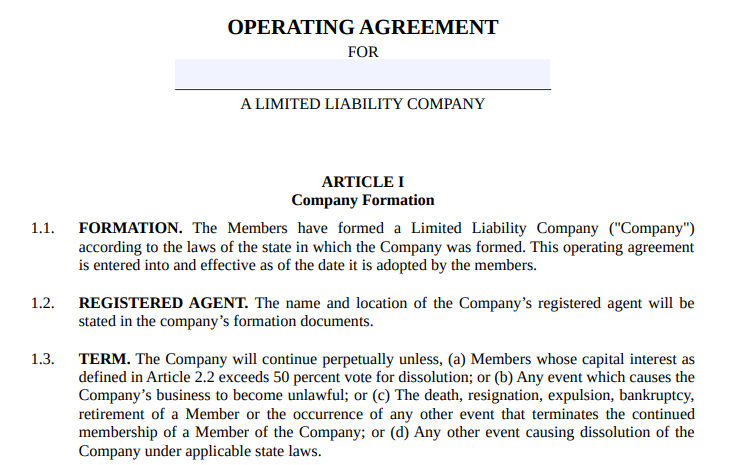
A "Operating Agreement" is a legal document that establishes the structure of an LLC and the terms and conditions of operation among the LLC members. This agreement defines the rights, responsibilities, and obligations of the members, as well as procedures for decision-making, profit and loss distribution, conflict management, and other operational aspects of the company.
The Operating Agreement is a fundamental document for any LLC, as it provides a clear guide on how the company will be managed and operated. Many banks will ask for this document to verify your account.
If there are several partners, an alternative to avoiding the creation of a multi-member LLC is to establish the partnership agreement within the Operating Agreement. At elutax we have been offering this service for years with the option to notarize it. For additional information you can send us an email at info@elutax.com
Official IRS Draft as a reference by clicking here
Which LLC option is best for foreigners?
Multi-Member LLCs have a variety of advantages such as providing a valid economic motiveProtection against charging orders, Tax Optimization through Deductions, if there are foreign partners, the option to add a manager to provide privacy, etc. However, it is a more costly and complex structure where you will need a good advisor supporting the structure. On the other hand,
Single-Member LLCs Single Member LLCs bring earnings to Spain easily . If your billing is under $100,000 annually and you have no partners, the Single-Member LLC is your best option.. If your annual revenue is under $100,000 and you have no partners, a Single Member LLC is your best option.
If the sole purpose of establishing a multi-member LLC is to transfer shares to a second partner and establish partnership clauses, opting for this structure is not strictly necessary. However, if the intention includes selling in the United States, there is a U.S. partner, and the partnership agreement is more complex, then a multi-member LLC may be more appropriate and beneficial.
Key Differences between Member-Managed and Manager-Managed LLCs:
Management and Control:
- Member-Managed: In a member-managed LLC, all members actively participate in the daily management and decision-making of the business. This structure is similar to a general partnership and is ideal for small businesses where owners want to be directly involved in operations.
- Manager-Managed: In a manager-managed LLC, one or more designated managers (who may be members or outsiders) have the authority to handle daily operations. Members do not participate in day-to-day matters, but may retain power over key decisions. This option is suitable for LLCs with many members or members who prefer to be passive investors.
Privacy:
- Member-Managed: The names of all members may appear in public records and other documents, depending on state laws.
- Manager-Managed: Only the names of the managers need to be published or registered, which can offer greater privacy to investor members.
Operational Flexibility:
- Member-Managed: This structure can limit flexibility, as it requires the consensus or participation of all members for operational decision-making.
- Manager-Managed: Provides greater operational flexibility, allowing for a quicker response to business needs by centralizing decision-making in the managers.
Legal and Administrative Complexity:
- Member-Managed: Generally less complex and more straightforward in terms of legal and administrative structure.
- Manager-Managed: Can be more complex due to the need to clearly define the roles, responsibilities, and limits of authority of the managers in the operating agreement.
These differences are fundamental when deciding how to structure an LLC, as they directly affect how the business will be operated, how members' privacy will be protected, and how legal and financial responsibilities will be handled. The choice between a member-managed and a manager-managed structure should be based on the specific needs of the business, management preferences, and the long-term goals of the members.
At EluTax we offer comprehensive service for each of the aforementioned services, we collaborate with Bizee for the creation of LLCs remotely with the turn-key LLC. From the following link you will find all the information: Create LLC + EIN Online with Bizee
🔍 Dive deeper into the EluTax AI Wiki: