
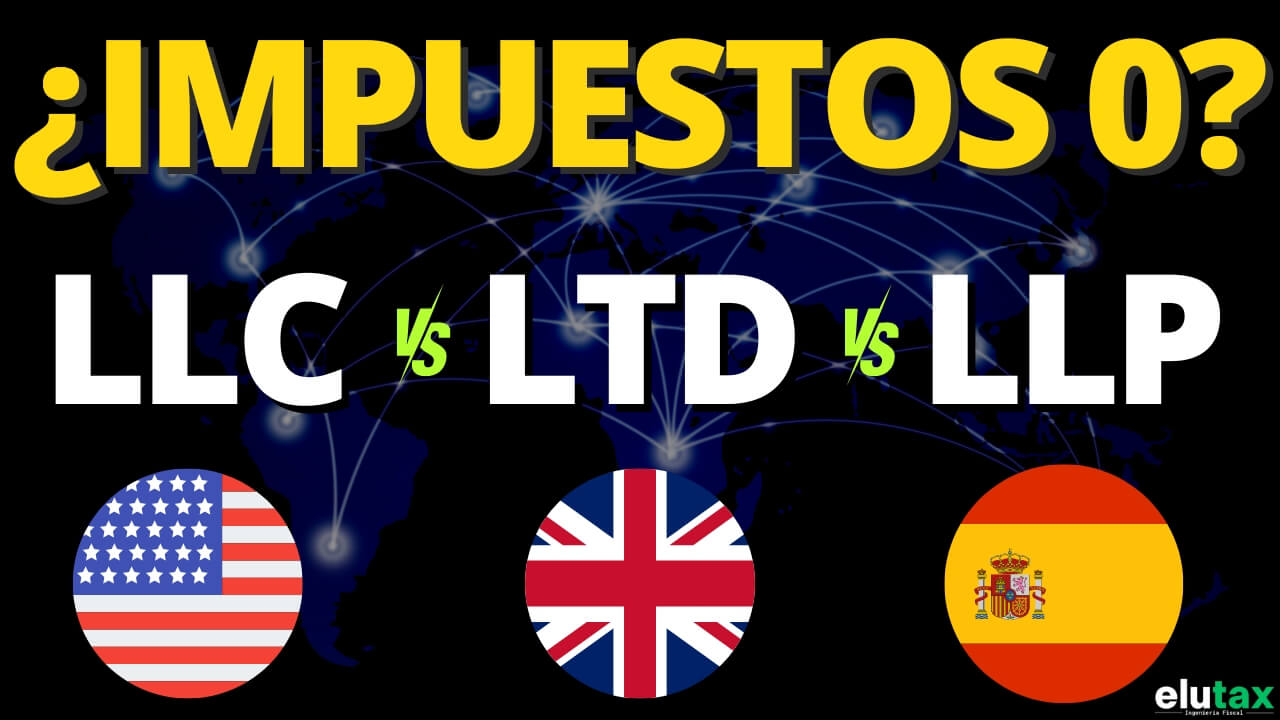
When establishing a foreign company for tax avoidance or to operate in another continent, two popular options are the LLC (Limited Liability Company) in the United States and the LLP (Limited Liability Partnership) in England.
Both are pass-through (transparent) companies with tax advantages for foreign administrators. They are established in tax jurisdictions with solid authority and legal security. The United States and England provide a stable and transparent regulatory framework.
On the other hand there are the LTD, limited companies in England with a 19% corporate tax but very flexible with deductible expenses, you can create accounts in wise, revolut business, stripe and even PayPal!
US LLC: Definition and Benefits
The LLC (Limited Liability Company) is a company in the United States that combines the advantages of the limited liability of a corporation with the flexibility and tax treatment of a transparent company. Some of the key benefits of an LLC include:
- Limited Liability: LLC members are not personally liable for the company's debts and obligations.
- Tax Flexibility: The LLC can choose to be treated as a pass-through or corporate entity, which allows optimizing its tax burden.
- Anonymity: Some states in the United States offer a corporate veil that protects the identity of the administrators.
- Simple Ownership Transfer: Ownership of the LLC can be transferred through the sale of shares.
- Annual Filings: LLCs file returns annually between May and April.
- Easy Creation: Creating an LLC is relatively easy when compared to other structures such as SLs in Spain.
- Cheap Maintenance: Maintaining an LLC costs about 500€ per year including addresses and state fees.
- Payment Gateways: With an LLC you have access to a wide variety of neobanks and payment gateways like Stripe, Wise, Mercury etc..
- Invoicing and accounting: LLCs file taxes once a year, it is not mandatory to request an invoice for all expenses. Any expense made from the company account is automatically considered deductible.
- 0 Taxes: If you do not sell in the USA you do not pay taxes, upon pass-through the profit is attributed to your person.
Create my LLC with Northwest →
Affiliate link: if you sign up through it, EluTax receives a commission at no extra cost to you. It does not replace professional tax consulting.
LTD in England: Definition and Benefits
A "Limited" (Ltd) is a limited company in the United Kingdom that can be created and operated by foreigners. The personal assets of the owners are protected in case of debts or financial problems of the company.
The benefits of operating an Ltd in the United Kingdom being a non-resident foreign Englishman may include:
Limited Liability: Ltd owners are not personally liable for the company's debts and obligations. This protects their personal assets in case of financial or tax issues.
International Reputation: The United Kingdom has a solid reputation in terms of business and financial environment. Operating a company registered in the UK can increase the trust of international clients and business partners.
Access to International Markets: A UK Ltd can facilitate access to the British and European markets. This can be especially valuable if you have plans to expand your operations in Europe.
Ease of Registration: The process of registering and creating a UK Ltd is relatively simple and can be done online.
Possibility of Operating Remotely: It is not necessary for you to be physically present in the UK to operate an Ltd. This can be beneficial if you manage the company from your home country.
Tax Benefits: The United Kingdom offers an attractive tax system for many companies. However, it is important to obtain tax advice specific to your situation and the nature of your operations.
Holding Company: LTDs are perfect for being operated with Holdings.
Access to Trusts: In the UK there is access to tools like trusts; it is legal and ideal for protection and anonymity. In Europe, for example, this figure does not exist.
Asset Transfer: Interchangeable partners do not have to carry out any administrative procedures in the UK. They are ideal for transfers, inheritances, etc.
Structure Flexibility: An Ltd offers flexibility in terms of ownership and management structure.
- Deductible Expenses: LTDs are much more flexible than companies in Spain regarding expense deduction; you can even make deductible investments.
- Payment Gateways: Just like LLCs, you can create accounts on Wise, Stripe, and even—unlike LLCs—on PayPal.
It is important to keep in mind that, in addition to the benefits, there are also legal, tax, and administrative considerations that you must take into account when operating a company in a foreign country. Each situation is unique, and it is essential to seek legal and financial advice before making important decisions.
Taxes of an LTD in England
The taxes of LTDs in England managed by foreigners are: the corporation tax of 19% and the tax on dividends, which is usually around 8% depending on the amount; the first €2000 are exempt.
The dividend distribution will not be taxed by England but by the Tax Agency of the country where the shareholder resides, so the dividend tax varies depending on the country in question. Said distribution must be reported on the income tax return.
Regarding these taxes, it is worth noting that it can be optimized with a avoidance correct strategy. For example, with investments or off-shore companies invoicing the LTD, pensions, etc. You can also choose to incorporate a nominee to your LTD, contact us if you are interested.
LLP in England: Definition and Benefits
LLPs (Limited Liability Partnership) are a type of transparent companies in England ideal for multiple partners; unlike an ltd, the LLP does not pay taxes in England as long as you do not sell in England.
Some of the advantages of foreign-managed LLPs are:
- Liability Protection: Partners are not personally liable for the debts and obligations of the LLP.
- Management Flexibility: Partners can establish customized profit-sharing agreements and management roles.
- Favorable Tax Implications: The profits and losses of the LLP are passed on to the partners and taxed on their personal returns.
- Annual Filings: LLPs, just like LTDs or LLCs, file taxes annually, unlike the quarters in Spain.
International Reputation: The United Kingdom has a solid reputation in terms of business and financial environment. Operating a company registered in the UK can increase the trust of international clients and business partners.
Access to International Markets: A UK Ltd can facilitate access to the British and European markets. This can be especially valuable if you have plans to expand your operations in Europe.
Ease of Registration: The process of registering and creating a UK Ltd is relatively simple and can be done online.
Possibility of Operating Remotely: It is not necessary for you to be physically present in the UK to operate an Ltd. This can be beneficial if you manage the company from your home country.
- Payment Gateways: Just like LLCs, you can create accounts on Wise, Stripe, and even—unlike LLCs—on PayPal.
| LTD | LLP |
|---|---|
| Can be registered and managed by a single person – director and shareholder | It requires a minimum of two members to establish an LLP. |
| The liability of shareholders or guarantors is limited to the amount paid or unpaid on their shares, or to the amount of their guarantees. | The liability of LLP members is limited to the amount each member guarantees to pay if the company runs into financial difficulties or is liquidated. |
| A limited company can receive loans and equity investments from external investors. | An LLP can only receive loan capital . It cannot offer equity shares in the business to non-LLP members. |
| Limited companies pay 19% corporation tax | Being transparent, members pay income tax. The LLP itself has no tax obligation other than VAT. |
| You must notify the Company Secretary every time you change a director or shareholder. | It is easier to change the internal management structure and profit distribution in an LLP. |
LLC vs LLP Differences
Despite sharing similarities in terms of limited liability, LLCs and LLPs present key differences that must be considered when making a decision:
- Geographical Location: While the LLC is common in the United States, the LLP is more prevalent in the United Kingdom.
- Management and Structure: The LLC can have a more basic management structure compared to the LLP, which generally resembles a partnership.
- Partnership: The LLP is a multi-member partnership whereas the LLC sole proprietorship is single-member, though multi-member LLCs also exist.
- Creation Time: LLPs can be created in less than 2 days while LLC EINs are taking up to 2 months. (Elutax processes EINs in 5 days)
Frequently Asked Questions
Is it legal to have an LLC or LLP abroad?
Yes, both the LLC in the United States and the LLP in England are legal structures to establish a business presence abroad. However, it is important to ensure compliance with legal and tax requirements in both jurisdictions.
What taxes do LLCs have in the United States?
The tax implications of a LLC in the United States vary depending on the choice of tax structure. In a single-member LLC (pass-through), profits and losses are passed through to the members and taxed on their personal tax returns.
In the USA, informative forms must be filed 5472 and 1120, if you do not sell in the United States you do not pay taxes.
What are the taxes associated with an LLP in England?
In a LLP in England, profits and losses are passed on to the partners, and each partner reports their share on their personal tax returns. Income tax or personal income tax (IRPF) varies according to the tax regulations of the partners' nationality.
Do I have to report to the Tax Agency (Hacienda) if I have an LLC?
No, residents in Spain must report to the Tax Agency only if the total assets of said LLC exceed €50,000. In that case, you must report the LLC as an asset abroad using form 720. However, as a Spanish resident, you are obligated to report income obtained abroad and declare it in your personal income tax (IRPF). (If your LLC is not yet profitable, you don't have to report it to Hacienda) 😉Does the Tax Agency know if I have an LLC in the USA?
Neither the states nor the IRS
inform foreign entities report to foreign entities Can I have an LLC and an LLP at the same time?
What business models are suitable for an LLC?
Recommended activities to invoice from an LLC are generally those that they have no physical nexus or employees. If you activity is online and you do not need an office, warehouse, employee.. to carry out your activity then invoicing it from the LLC will not be a problem.
Restaurants, real estate, services requiring physical presence, a warehouse or office with materials needed for the activity... These are some examples that should not be billed from a foreign company.
E-Commerce as long as you outsource everything, logistics, importation, customization, etc. Dropshipping in that case is viable to bill with the LLC. Consulting, trading, digital services or products, freelancer, online training, content creator, affiliate marketing, media buyer. These are some businesses suitable for the LLC.
Yes, it is possible to have a
and a LLC in the United States at the same time. However, this might require careful tax and legal planning. You can ask us at info@elutax.com LLP in England Do you have to pay VAT with an LLC or LLP?
Yes and no, if your invoicing to Spanish clients
does not exceed €10,000does not exceed €10,000With LTDs or LLPs you do not pay VAT until you exceed €80,000
in the USA
Do I have to be self-employed if I have an LLC?
No,if you own an LLC and are a Spanish tax resident you are not obliged to be self-employed to declare that income, you can simply pay the corresponding VAT.
Conclusion
An LLC is ideal for small online businesses online businesses federal crime tax evasion the improper use of an LLC for the purpose of tax evasion.
Single-Member LLCs LLP It is important to highlight that LTDs, unlike LLCs or LLPs, are subject to Corporate Tax. Therefore, it is necessary to have a second company abroad or implement a
Multi-Member LLCs LTD tax strategy
to optimize your taxes. The possibilities are varied and include investments, allocation of losses, cross-invoicing etc. LLC vs LTD: Key Differences for Foreigners in 2026 | EluTax etc.