What to look for if what you want is privacy (and not a crime)
Almost no one arrives here out of linguistic curiosity. People arrive looking for one of these two things: hiding who is behind something, or protecting an estate. The first, via a front man, is a simulation and exposes you to criminal liability. The second has perfectly legal avenues.
These are the real alternatives, depending on what you need:
| What you want | The legal avenue |
|---|---|
| Keeping your name off public registries | LLC with registry privacy (the real owner is always on record with the tax authorities) |
| Separating personal wealth from business risk | Limited liability company |
| Planning succession and protecting assets | Fiduciary structures declared |
| Paying less tax legally | Changing your tax residency or taking advantage of Beckham Law |
| Bringing undeclared money to light | Voluntary regularization (art. 27 LGT) |
The difference between all of these and a front man is the same in all five cases: in the legal avenues the real owner is always known to the Administration. What changes is who sees it in a public registry and how it is taxed. Hiding it from the tax authorities is what turns a structure into a crime.
Which one fits your case? It depends on what you want to protect and where you are a tax resident. Ask for free at Elu, our tax AI, or review it in a €99 consultation.
The 4 figures in 30 seconds
| Figure | Nature | Default legal | Main risk |
|---|---|---|---|
| Front man (Testaferro) | Real owner without being one | NO | Tax crime, laundering, asset concealment |
| Nominee | Contractual nominal representative | YES | Fraud if real ownership is hidden |
| Trust | Anglo-Saxon fiduciary structure | YES | Fraud if not declared (Form 720) |
| Fideicomiso | Civil law wealth figure | YES | Fraud if taxes are evaded |
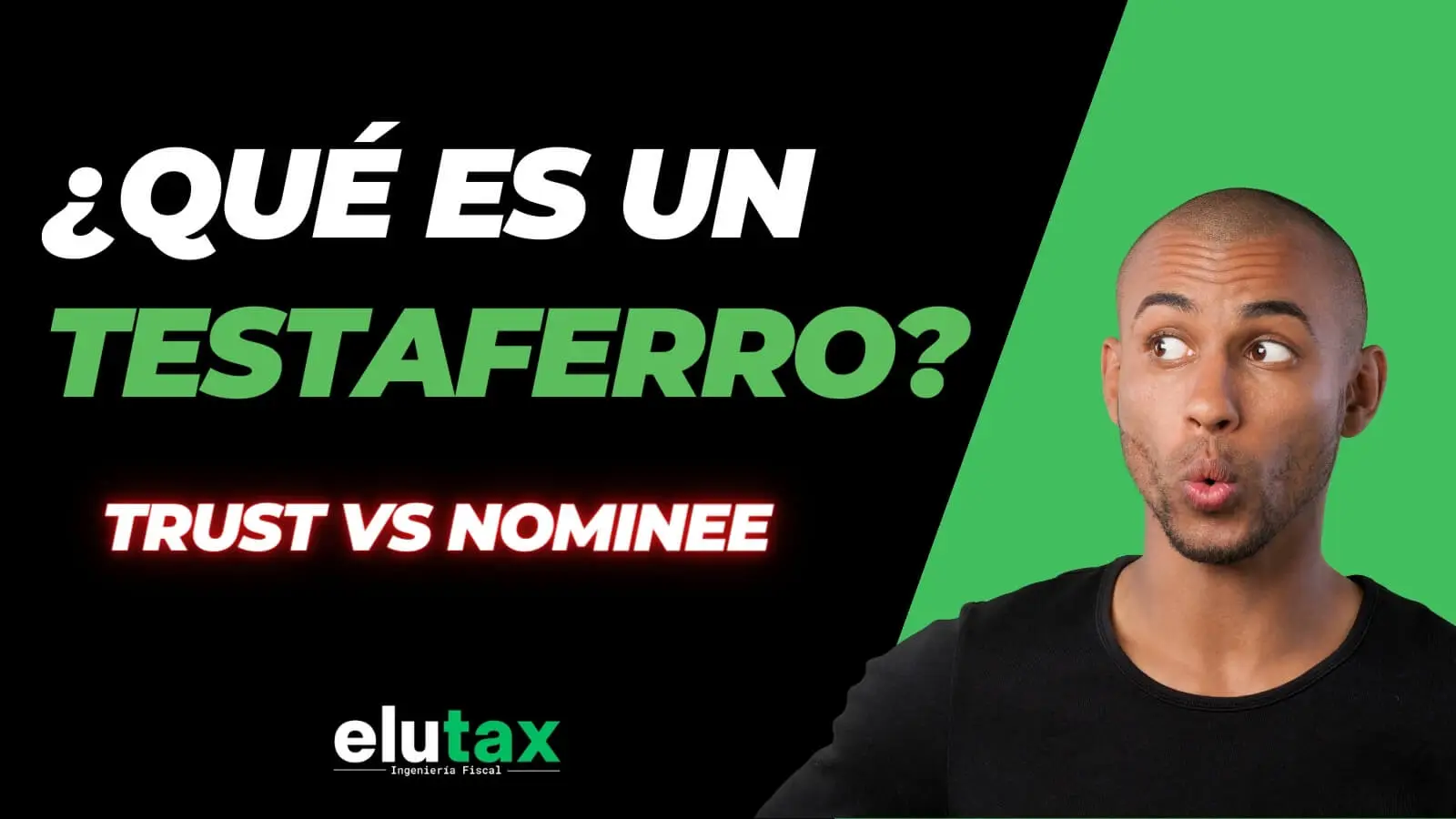
What exactly is a front man (testaferro)?
The term comes from the Italian testa di ferro and designates someone who lends their name so that another person formally holds the property without appearing in public registries.
When it is tax fraud: when the interposition prevents the beneficial owner from paying taxes on the income they are holding out as their own. Article 305 CP and Article 16 LGT are the instruments most used by the AEAT.
Criminal consequences: the front man can be prosecuted as an accomplice or co-perpetrator of tax crime (art. 305 CP), money laundering (art. 301 CP), and asset concealment/fraudulent conveyance (art. 257 CP).
What is a nominee and when is it legal?
It is a common figure in jurisdictions such as the UK, Gibraltar, Malta, or Ireland. It requires a nominee agreement, powers of attorney, and a declaration to the beneficial ownership registry (EU Anti-Money Laundering Directive).
When it crosses the line: when used to prevent the Spanish Tax Agency (Hacienda) from identifying the true recipient of income. A tax resident in Spain who uses a nominee to avoid declaring dividends may incur a tax crime if the amount exceeds €120,000.
Trust vs. Fideicomiso: the key difference
The technical difference: the trust originates from common law (ownership divided between legal owner and equitable owner); the fideicomiso originates from Roman civil law (unitary conception of ownership).
Criminal consequences in Spain in 2026
Penalties for fraudulent use are articulated through Article 305 of the Criminal Code:
- Basic type (amount >€120,000): prison sentence of 1 to 5 years and a fine ranging from equal to up to six times the amount
- Aggravated type, Art. 305 bis (amount >€600,000): up to 6 years in prison
- Money laundering (Art. 301 CC): if the assets have an illicit origin
- Asset concealment / Fraudulent conveyance (Art. 257 CC): if the collection of tax debts is thwarted
Voluntary regularization (Art. 305.4 CC) allows criminal liability to be extinguished if you declare and pay before the Spanish Tax Agency (AEAT) initiates formal proceedings.
How does the Tax Agency know if I have a trust or fideicomiso?
The AEAT receives automatic information through the CRS/OECD y FATCA standard with the U.S., which obligate financial institutions in more than 100 jurisdictions to report balances and account holders. The DAC6 Directive also obligates intermediaries to report potentially aggressive tax planning structures.
In the complex legal and financial framework, terms like straw man (testaferro), trust, nominee, fiduciary / trustee (fiduciario) y trust / fideicomiso frequently arise, each representing specific structures and roles. Below is a comprehensive guide to each concept, accompanied by examples for clearer understanding.
1. Straw Man (Testaferro): What Is It and How Is It Used?
A straw man is a person who agrees to appear as the owner of assets instead of the actual beneficiary. This can be done legally, but sometimes it is used fraudulently to conceal true ownership.
Example: Maria, an investor, uses a straw man in a financial transaction to keep her identity anonymous.
2. Trust: A Structure for Asset Protection
Trust, this term is of Anglo-Saxon origin; a legal structure in which an individual or entity (trustee) holds and administers assets for the benefit of others (beneficiaries). This arrangement is used to protect and distribute assets according to the trustor's wishes.
Example: The González family establishes a trust to protect their assets and ensure that wealth is distributed equitably across generations.
3. Nominee: Their Role in Legal Representation
A nominee is a person or entity officially designated to act on behalf of another in specific matters. This figure is common in international business transactions, where a foreign entrepreneur can appoint a local nominee to comply with legal ownership requirements.
Example: A foreign company appoints a local nominee to comply with ownership regulations in a foreign country.
4. Fiduciary / Trustee: Their Responsibility in Asset Management
The term fiduciary refers to a person or legal entity that assumes the responsibility of managing assets for the benefit of others.
Example: A renowned bank acts as a fiduciary when managing its clients' investment funds.
5. Fideicomiso: Guaranteeing Asset Distribution
A fideicomiso is a legal contract that specifies how assets must be managed and distributed. It is used to ensure that goods are allocated according to the trustor's wishes. Generally, behind a Fideicomiso there is a Fiduciary.
Example: Carlos creates a fideicomiso to ensure that his art collection is preserved and shared with the community after his passing.
Differences between Fideicomiso and Fiduciary: The fideicomiso is the legal entity and the rules, whereas the fiduciary is the one who implements and administers those rules.
Additional Concept: Shell Company
A relevant term to consider in the context of legal and financial structures is "shell company". A shell company is an entity created for the purpose of hiding or disguising the true nature or ownership of assets and transactions.
Shell Company: Its Function in Financial Opacity
A shell company is used to provide an additional layer of separation between assets and their actual owners. This can be done legitimately for reasons of privacy or to protect assets from potential litigation. However, it can also be used fraudulently for illicit activities such as tax evasion or money laundering.
Example: Juan, a businessman, sets up a shell company to own real estate without publicly revealing his stake. This not only protects his privacy but also adds a layer of complexity for those attempting to determine actual ownership.
Importance in Financial Planning
Understanding how a shell company works and when it is ethical or legal to use it is crucial in financial planning. While it can offer legitimate advantages, its misuse can result in severe legal consequences. It is vital to seek professional advice when considering the establishment of a shell company to ensure regulatory and ethical compliance. You can contact us at info@elutax.com
Trust:
- Definition: A trust is a legal and financial structure where an individual (trustee) holds the title to properties or assets for the benefit of another person (beneficiary).
- Control: The trustee administers and controls the trust assets according to the terms specified in the trust agreement.
- Definition: A fideicomiso is a legal figure that establishes the transfer of assets or properties to a fiduciary for the benefit of another person or entity.
- Purpose: It is used for asset management and protection, estate planning, and ensuring that assets are used according to the trustor's intentions.
- Definition: The fiduciary is the person or entity designated to manage the assets of a trust or fideicomiso for the benefit of the beneficiaries.
- Responsibilities: The fiduciary has the legal responsibility to act in the best interest of the beneficiaries and manage the assets in accordance with the terms of the trust.
- Definition: A straw man is a person who acts as the nominal holder or owner of assets on behalf of another person to conceal the true owner's identity.
- Use: It is often used with privacy intentions to hide the actual ownership of assets and evade/avoid taxes or other legal responsibilities.
Differences between concepts:
Trust and Fideicomiso: Both terms are used interchangeably in many contexts, but the trust is more common in Anglo-Saxon jurisdictions, whereas the fideicomiso is the equivalent term in Spanish-speaking legal systems.
- Differences between trust and nominee. While a trust implies a legal agreement where the trustee has control over assets for the benefit of others, a nominee is simply a nominal holder without the responsibility of managing assets or making decisions.
- Differences between fideicomiso and the fiduciary. The fiduciary, whether a person or entity, is appointed to manage the assets of a trust for the benefit of the beneficiaries. In contrast, the fideicomiso is the legal figure that establishes the transfer of assets to the fiduciary, detailing how they must be used for the benefit of another entity.
- Difference between a ghost company and a shell company. While the ghost company exists only on paper and is often used for illegitimate activities, the shell company is a legal structure that seeks to conceal a company's ownership and operations in a legitimate manner.
Do you have a structure with a nominee, trust, or LLC?
We analyze whether your situation has tax risks in Spain and how to regularize it before the AEAT takes action.
Confidential consultation →